Civil Discourse – from Jewish Tradition to Modern Street Epistemology

Below is a short introduction to a portion of a panel discussion by the International Institute for Secular Humanistic Judaism (IISHJ). The title of the panel was Arguing Jewishly. I chose to talk briefly about the Jewish tradition of civil discourse and a way of having discussions based on Street Epistemology. I cannot think of a better time for us to dive into learning to have civil discussions.

From your left to right: Rabbi Denise Handlarski, Rabbi Susan Averbach, and Rabbi Jodi Kornfeld

Hello, welcome. Since our topic is about creating a civil way to have discussions based upon our Jewish tradition, let’s start with an uncivil discussion – one we are likely familiar with if we spend any time on social media.

Jess: You can’t live a moral life without God

Allie: That’s ridiculous. There are plenty of atheists who are morally responsible!

Jess: Nope – scratch the surface and you’ll see that they were raised by God fearers.

Allie: that’s not true – we are third generation socialists!

Jess: Ahhh, so you’re not really moral at all. You think capitalists are scum. You believe in revolution. You have no moral compass.

Allie: That’s absurd. We care more than you do!

Jess: You’re ridiculous – look at history – Stalin!

Allie: Stalin wasn’t a socialist!

Jess: oh, yeah!

Allie: Yeah! Look at the crimes committed by God infused true believers – the Twin Towers!

Jess: That’s not what I’m talking about.

Allie: God is God – you don’t know what you’re talking about. What idiocy!

and so on and so on….

So might go a modern uncivil argument. Before my 8 minutes are over, we’ll look at an alternative form of this argument.

We already have a model for civil discourse in the Jewish tradition.

The Sages; that is, the voices heard in Mishna and Talmud, our post-biblical, rabbinic literature, made a distinction between arguing for the sake of heaven. [Makhlokhet L’Shem Shemayim] or arguing like Korach. For the sake of heaven – read as for the benefit of all or for the greater good. Korach, they argue, who rebelled against Moses and was swallowed up for his rebellion, argued for the sake of his own ego. 

The sages weren’t always civil. Their civility evolved from the violent expression of disagreements between the house of Shammai and the house of Hillel. There is a story in which the students of Hillel are slaughtered by the House of Shammai, but the latest redactors of the Talmud, made sure to edit and add to stories to require respect of all parties in an argument.

I read a page of Talmud a day and recently came upon a passage where one Sage called another a fool and I could feel the difference from all other passages I had been reading over the course of the past few years. Then – boom – a line later the beam of the study house falls over and the walls start to come down – all due to the lack of respect between these two scholars.

You can find clear messages in Talmud regarding how to treat each other during arguments. Here are a couple examples.

Anyone who humiliates another in public, it is as though he were spilling blood.

Bava Metzia 58b

It is more comfortable for a person to cast himself into a fiery furnace, than to humiliate another in public 

Bava Metzia 59a

So what do arguments have in common in the rabbinic tradition; what is argument for the sake of heaven – read – for the benefit of all – for the greater good?:

1. Debate the issues without attacking people and harming relationships.

2. Check your motivation: are you trying to win an argument or solve a problem?

3. Listen to the other side and be open to admitting that you might be wrong.

4. Consider that you both may be right, despite holding opposite positions.

What rules did our friends Jess and Allie break.

1. they attacked each other

2. they just want to win their argument

3. they were not listening to each other and neither want to admit they may be wrong

4. are they both right – maybe, maybe not – that’s okay

Here is how the conversation might have gone. I’m basing this new conversation on a method called street epistemology. Ask me about that later. Their method fits well with the requirement that we respect each other when we have discussions. They even go a step farther and encourage a person who makes a claim to think through their own process of thought that brought them to make a claim in the first place and even possibly change their own mind.

Jess and Allie – take 2

Jess: You can’t live a moral life without God

Allie: Interesting, you think that a person cannot do the right thing if they don’t believe in God?

Jess: Yes, that’s what I’m saying.

Allie: Interesting. On a scale of 1 to 10, where 10 is your absolute certainty, what number would you rank your claim?

Jess: Hmmm, I’d probably give it an 8.

Allie: An 8, why not a 10?

Jess: Well, I have known some pretty kind and righteous people who don’t believe in God and I also know some folks who seem to be quite religious, but are selfish and mean-spirited. Hmmm…..

Allie: Any other thoughts that come to mind about that?

Jess: I’ll think about this. Thank you.

What is the change in orientation shown by this second way of having this argument? First, it’s not really an argument – it’s a mutual exploration of a claim, with two people who show respect to each other and who are looking for the truth – as unreachable as it may be. It’s a start. 

To have this sort of discussion requires what I’m terming the three c’s.

Composure – not being reactive

Compassion – caring about the person you are talking with.

and Curiosity – genuine curiosity – if you respect someone, be curious about what process led them to their claim.

Yehuda Amichai intuitively favored this approach in his poem, 

The Place Where We Are Right. I’d like to end with this powerful poem.


        by Yehuda Amichai
 
From the place where we are right
Flowers will never grow
In the spring.
 
The place where we are right
Is hard and trampled
Like a yard.
 
But doubts and loves
Dig up the world
Like a mole, a plow.
And a whisper will be heard in the place
Where the ruined
House once stood.

Thank you.

Postscript: This talk was given at the International Institute for Secular Humanistic Judaism. https://iishj.org

The broad movement that this institute serves is The Society for Humanistic Judaism. https://shj.org

Street Epistemology is taught online and you can find many YouTube examples. If you would like free training in street epistemology go to: https://streetepistemology.com

A group of members of The Middle Way Society, including myself, are studying and practicing street epistemology. Check us out. https://www.middlewaysociety.org

Looking for Jewish Community

You know you’re a Jew when you hear about anti-Semitism and you want to join with other Jews in community. Although a small percentage of Jews in my part of the U.S. are already affiliated, most of us are not. Recently I heard about a person who is about to convert to Judaism questioning whether to go through with it in these troubling times. My reaction goes in the opposite direction. I feel an affiliation pull in my gut in spite of all of my tendencies to want to be an independent, unaffiliated individual. Perhaps you are feeling the same way.

I have at least temporarily resolved my conflict about Jewish affiliation after several years of learning with a group called The Middle Way Society. There I found a roadmap for integrating opposing desires; the desire to be independent and the desire to be affiliated.

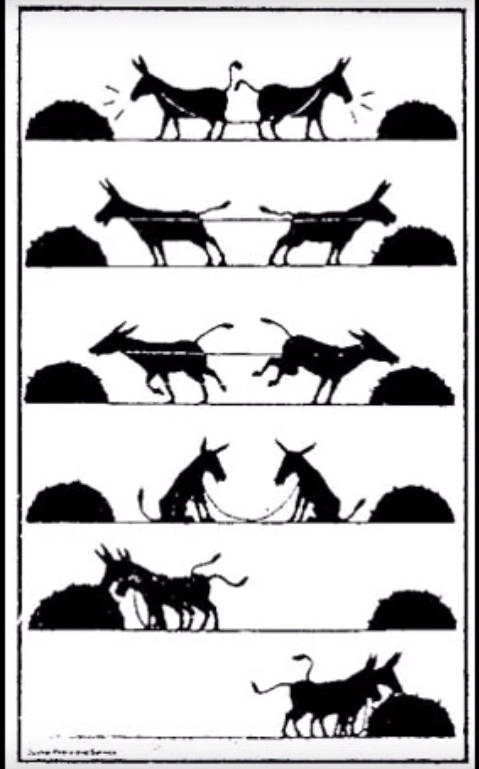
mules

These mules represent opposing desires. In the top three pictures you see the mules straining – one pulls toward one side and the other pulls toward the other side. Each side represents an absolute belief. For myself, one mule represents being a strong independent individual separate from Jewish community. The other mule represents being affiliated with other Jews and friends in community. I try to explore my underlying belief for each of these desires.

If I sit with my thoughts and try to understand the underlying beliefs that fuel the absolute idea that I should be independent of affiliation I find that I have a prejudice about Jewish tribalism. Even though the Jewish group I have affiliated with in the past is open and welcoming, I have an old association from past experience of Jewish exclusiveness.

When I sit with my thoughts about wanting to be affiliated I uncover beliefs that I thought were long buried. The world is dangerous and people, even well-meaning people, can quickly become anti-Semitic. I need to cleave to my people and keep us alive, as others have done in the past. We have a long history of persecution and yet we still survive. I need to be involved in ensuring our survival. Also, there is much wisdom to be found in Jewish texts, and the creative interpretation of these texts can be rewarding in many ways.

I needed to reframe the beliefs that accompany my desire both to be independent/assimilated and Jewish/affiliated.

With some thought, I could integrate both desires. I can be an independent thinker and be in Jewish community. Being in Jewish community does not require that I be tribal. Being an independent thinker is perfectly acceptable within the secular humanistic Jewish community where I was ordained as a rabbi.

You may want to try this exercise with the mule metaphor also. My description of integrating desires is a “nutshell” explanation. Please explore the Middle Way Society website if you want to go into more depth.

There is great satisfaction in integrating our desires. We each have our own story, with competing desires and beliefs that need to be explored. If you find that you also are feeling the pull towards affiliation, and if you, like me, are uncomfortable in traditional synagogue settings where you have to say words you don’t believe, here are some ideas.

Society for Humanistic Judaism (SHJ)

From their website:

If you believe that cultural Judaism is important to a contemporary Jewish identity and that cultural Jewish communities and an organized Humanistic voice enhance the Jewish experience for secular and Humanistic Jews, then SHJ is for you.

Humanistic Judaism embraces a human-centered philosophy that celebrates Jewish culture without supernatural underpinnings. Humanistic Jews value their Jewish identity and the aspects of Jewish culture that offer a genuine expression of their contemporary way of life. We believe in the human capacity to create a better world.

If you like to learn about groups through videos, there are quite a few on YouTube – just type in Society for Humanistic Judaism.

Judaism Unbound

judaism unbound logoI have been religiously listening to Judaism Unbounda podcast that supports American Jews to “re-imagine and re-design Jewish life in America for the 21st Century.” From their website:
Judaism Unbound values the ways that you choose to connect to Judaism, whether through rituals steeped in millennia-old traditions or through entirely new paradigms that ancient Jewish texts never dreamed of; whether your Judaism includes participation in Jewish communal organizations or not; whether you live and breathe Jewishly 24/7 or you just want to connect once or twice a year; whether you think of yourself as Jewish, half-Jewish, Jewish-and-X, partly-Jewish, not-Jewish, or Jew-ish. 

During a recent gathering to celebrate the 50th anniversary of the Society for Humanistic Judaism, a panel of humanist rabbis were interviewed by Daniel Libenson for Judaism Unbound. Be on the lookout for this episode!

Past episodes have included an interview with Rabbi Adam Chalom, leader of Kol Hadash Humanistic Congregation in Lincolnshire, Illinois, and an interview with Rabbi Judith Seid, Rabbi of TriValley Cultural Jews in Pleasanton, California.

SecularSynagogue.com

secular synagogue logo

I’ve recently joined Rabbi Denise Handlarski’s online community. The purpose of SecularSynagogue.com is concisely described on the website:

Together we are co-creating a community online for Jews and those who wish to hang out with Jews, with inspiration, resources, challenges and discussion. The purpose of this group is to enhance our spiritual lives and foster personal growth and communal connection. The ultimate goal is two-directional: we will become our best selves and, bringing our best selves, we will make a better world.

And, one can enjoy being part of this community from your couch! Rabbi Handlarski explains her purpose in forming this group on Judaism Unbound, Episode 165.

IMG_0779

Humanistic Judaism and SecularSynagogue.com share a Middle Way approach, especially in regard to avoiding fixed beliefs and being open to experience. My Jewish path will be paved with stones from The Middle Way Society, The Society for Humanistic Judaism, Judaism Unbound, and SecularSynagogue.com.

In spite of the rise in anti-Semitism I don’t think there has ever been a better time to be Jewish; the choices are many.

What does faith mean to you?

What does faith mean to you? Is faith only possible if one has an absolute belief in a particular religion? If you are a Jew, do you state, as Maimonides did,

“I believe with perfect faith in the coming of the Messiah, and, though he tarry, I will wait daily for his coming.”

Or do you declare every day, or at least weekly . . . maybe yearly? . . . this?

“Hear O Israel, The Lord Our God, The Lord is One. You shall love the Lord your God with all your heart and with all your soul and with all your might. And these words that I command you today shall be upon your heart. You shall teach them diligently to your children, and shall talk of them when you sit in your house, and when you walk by the way, and when you lie down and when you rise up. . . .”

shma-large-AD-300x198

If you are Christian, do you believe the following?

“We believe that Jesus Christ is the second person of the Trinity and is the only begotten eternal Son of God Who became flesh to reveal God to man, to fulfill prophecy, and to become the Savior of the lost world. In becoming man Jesus did not cease in any way to be God so that He is fully God and fully man inseparably united in one person forever.”

where_is_the_faith__by_irvinggfm-d3bws0d

Or, perhaps, this is quite familiar to you:

“I believe in God, the Father almighty,
creator of heaven and earth.

I believe in Jesus Christ, God’s only Son, our Lord,
who was conceived by the Holy Spirit,
born of the Virgin Mary,
suffered under Pontius Pilate,
was crucified, died, and was buried;
he descended into hell.
On the third day he rose again;
he ascended into heaven,
he is seated at the right hand of the Father,
and he will come to judge the living and the dead.

I believe in the Holy Spirit,
the holy catholic and apostolic Church,
the communion of saints,
the forgiveness of sins,
the resurrection of the body,
and the life everlasting. Amen.”

Perhaps you are Muslim and declare:

“There is no god but God. Muhammad is the messenger of God.”

Pakistan

Symbolizing the faith of Islam, the crescent moon is seen at sunset on top of the Faisal Mosque in Islamabad, Pakistan, Tuesday, Sept. 16, 2008. (AP Photo/Wally Santana)

If any of the above texts rings absolutely true for you, and you would prefer to have any of these statements further strengthened with my blog post, you will be disappointed. Please feel free to stop reading this and to go about your day.

To my fellow doubters and skeptics, I have one question: What does faith mean to you? Is it a word that you would feel more comfortable living without? Were you, perhaps, “burned” by it as a child, sending you running toward a more rational, enlightenment point of view? Perhaps you are comfortable with the word “faith” in a form that makes sense to you.

Several members of The Middle Way Society recently had a round-table discussion about what faith meant to us. I recommend that you listen to the podcast of this discussion.

The four participants in this discussion were Barry Daniel, active member and podcast interviewer for The Middle Way Society; Robert M. Ellis, philosopher and founder of The Middle Way Society; Willie Grieve, a Zen Buddhist who lives in Scotland; and me, a humanist rabbi. What we all had in common was a comfort in living with uncertainty. For me the faith of patience described by Maimonides takes the form of working toward a more messianic age – meaning toward a time when people are less violent and more loving; i.e., my point of view was political, but, at the same time rests on a belief that people are capable of change and that personal transformation has a positive effect on the world even if one is not politically active. Willie Grieve has an apophatic approach to faith, and, through a Buddhist practice, sits in the midst of uncertainty and mystery. Robert Ellis talked about two kinds of faith. First, one can have faith that the chair one is about to sit upon will not collapse under you. And second, and the one that we are mainly talking about here, is a faith in our values based upon our experiences. We need to think about what are the best things to have faith in. He pointed out that faith is often a shortcut to absolute beliefs, similar to those that begin this blog post. Willie Grieve shared an Alan Watts quote that distinguishes belief from faith:

“We must here make a clear distinction between belief and faith, because, in general practice, belief has come to mean a state of mind which is almost the opposite of faith. Belief, as I use the word here, is the insistence that the truth is what one would “lief” or wish it to be. The believer will open his mind to the truth on the condition that it fits in with his preconceived ideas and wishes. Faith, on the other hand, is an unreserved opening of the mind to the truth, whatever it may turn out to be. Faith has no preconceptions; it is a plunge into the unknown. Belief clings, but faith lets go. In this sense of the word, faith is the essential virtue of science, and likewise of any religion that is not self-deception.”

The particular religious point of view of which Alan Watts speaks is likely Buddhism, at least in its less institutional and more agnostic forms.

lotus-wallpaper

One of the most interesting questions that Barry Daniels posed to all of us was,

“Do you think it’s unhelpful that the world’s religions are described as faiths or is that okay?”

What do you think? Please listen to the podcast and join the discussion.