Moving from fear to joy

Have you seen the “horse learning about water” video? Some say this video has gone viral. I try to understand why. Here’s the link, if you would like to see it for yourself:

https://www.youtube.com/watch?v=yAQLkI3EpMk

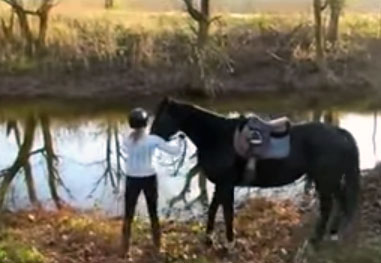
I’ve been pondering why the video has so much power. For those of you who may not have access to the video, I’ll briefly describe it. We see a pre-teen girl sitting on a horse, leading it toward the bank of a body of still water, likely a pond. The horse is clearly afraid and backs up. 1HORSE APPROACHING WATER The girl leads the horse again – again the horse backs away. In the next scene we see the girl, now off the horse, leading the horse by the reins toward the water. 2HORSE LEADING ON FOOTThe horse backs away again. But the girl is patient and persistent. She puts her foot in the water, and circles of water radiate from where her foot entered. She does this repeatedly and the horse looks at the rings of water and appears interested and puts its hoof in the water to3HORSE GIRL SHOWING WATER CIRCLESo. Slowly, the horse appears to be more and more comfortable in the water. The girl leads it in further. The horse splashes the water with glee. 4HORSE SPLASHThe girl laughs and laughs and the horse, its comfort level quite high at this point, keeps splashing and splashing. The joy of the splashing is punctuated by the girl’s infectious laughter. Pure joy is expressed by the horse and by the girl. If we empathize with these two beings we experience deep fear, patience, curiosity, and joy all in a period of 2 minutes and 19 seconds!

I wonder why I am so taken with this video. I begin by googling the symbolism of horses, since I know that if I had seen a mouse, or even a small child get acclimated to this water I don’t think I would have responded as strongly as I did. My search is unsuccessful – I mainly find posts about spirit animals and the meaning of horses in dreams. These posts do not resonate for me at all. I’m left to my own imagination – so here goes:

Horses are powerful creatures. The level of fear that I experience if I identify with this powerful creature is high. I am that horse and I feel the strong discomfort of discovering something new that scares me to the core of my being. Something guides me, though, to face up to this fear. I see someone else modeling comfort with water, and I realize that with this support and guidance, maybe I can try to face my fear. Not only is the fear overcome, but also the experience that follows is indescribably joyful.

I find myself wondering about what I’m afraid of. What is standing in the way of my joy? My first thought is that I am afraid to express my feelings to family and friends. I grew up in a fairly non-expressive family, the reins held back because of fear of total loss of control and mental illness, a real and persistent problem in my mother’s family. As I write this, the tears come, so I think this is real. The water in the video perhaps symbolizes life and the free and full expression of emotion. This is what I have to learn to splash in and not back away from. Luckily, I have the good fortune of having a persistent guide, who, though I resist again and again, keeps grabbing my reins and pulling me toward the water. Perhaps this is why the viral horse video has so much appeal for me. How about you? What is your fear? What stands in the way of your joy?

From black and white to grey

My husband and I like to relax in the late evening by watching a movie or a television series. Lately we’ve been watching Girls. Have you seen this series? It’s about young twenty-somethings in Brooklyn and their angst over supporting themselves, expressing themselves, their relationships, sex, and life issues in general. We watched a couple Season 2 episodes (and if you comment on this post, please don’t reveal anything . . .we’re taking this slowly), and I woke up thinking about these characters and how self involved they are. As a boomer I ask myself why I would

LenaDunham be interested in such self-involved people. I tend to be judgmental and I don’t like that about myself, but why would I be interested in this program? None of the characters do anything for anyone else. The closest thing to service is that one character is a high-end hostess. Of course, the main character is a writer and perhaps what she is writing will have relevance to others – though perhaps not. At one point she has a writing assignment to get out of her comfort zone, to take cocaine and go wild and write about it. I’m not sure how comfortable I am with that scenario, although, perhaps the idiocy that transpires in the episode is a life lesson we might take from the story. Or maybe she is doing art for art’s sake. As I think that thought I have an “aha” moment! Over the past week I’ve been photographing my old paintings that I’ve had stored in the basement for as long as 30 years. I no longer have room to store these paintings and will be releasing them to family, friends, and non-profit institutions that will display them. This morning I thought about why I had stopped being a painter and chose, instead, to become a humanist Jewish leader and then a rabbi. Here is a short version of the story.

I grew up conservadox, attending a Conservative congregation, but with my mother keeping the law in a more orthodox way than most of the congregants. However, as a teenager I left the orthodox path after witnessing hypocrisy within my community; my civil rights activist rabbi was the first to abdicate to “blockbusting,” moving out of our community at the first sign of an African-American family moving in. I was quite appalled, as only the very young can be appalled; I saw everything in black and white, and had zero tolerance for hypocrisy. It was easy to be disillusioned as an adolescent.

woc_vietnam-antiwar-march-1968

photo from Getty archives

When I went to college and became active in the anti-Vietnam War movement, I thought about World War II, and believed that as a Jew it was my obligation to take a stand, and not let a people be destroyed the way my people was destroyed in Europe. My activism was first curbed by the dominant-male personalities of the leadership within the student left. I joined the women’s liberation movement, assuming that women would be more respectful than men. Of course I was wrong. I discovered that to simply state what you believe is right, and to fight to create change without looking within oneself, can be counterproductive. One doesn’t change other people’s minds unless one totally respects the other person, whether or not they agree with you. To nurture the ability to hear another person requires a great deal of effort and skill. At the time of my disillusionment with political activism I wasn’t ready for the task, and I turned to create my own world of paintings. This didn’t require any effort on my part to change anyone but myself. I painted some beautiful paintings, showed these in galleries, received a fair amount of acknowledgment for my efforts, but felt dissatisfied—I think, at least in part, because I was raised as a Jew with a sense of obligation to a community (and not just a community of art lovers).

EXPRESSIVE2

If you’d like to see more of these you will find them here: jubusuart.wordpress.com


So, if I wasn’t going to change the world through political activism or art what did I need to do? At the same time that I asked myself this question, my daughter completed a multicultural curriculum at her public school. She became interested in her own cultural roots. It was time to look for a Jewish community for my children! I searched and found a local chapter of the Society for Humanistic Judaism and we all went to Yom Kippur services. This was the beginning of a long involvement with humanistic Judaism. This involvement led me back home to my Jewish roots. Soon after joining Kol Hadash, I was asked to go for training to become their leader. I completed this training in 2 years and led the group for 5 years.

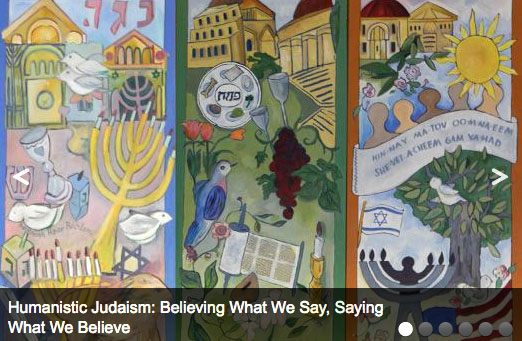
Check out shj.org to learn more about Humanistic Judaism

Check out shj.org to learn more about Humanistic Judaism

Acting as a spiritual leader for Kol Hadash was a challenging and rewarding experience. I found, however, that the more I learned about Judaism, the more I didn’t know. After stepping down from my leadership role in Kol Hadash, I embarked on a journey of Jewish learning that brings me to today. My Jewish learning led to my ordination as a rabbi in November 2014 and will be a permanent part of my life.

Now, I, the rabbi, take the painter’s, my, paintings and photograph them. I lift each heavy painting out the side door of my house, haul it onto a bench, lean it against the house, and take a photograph. I go back and forth more than 30 times over a week. Sometimes I gasp at the beauty of the piece and this brings me into a spiritual zone that I was in when I produced the painting. Perhaps my criticism of Girls is really a suppression of the artist in me. We humans are complex. We can be personally creative and socially responsible. I hope that by my age I can learn to think in grey and not just black and white!

Simple pleasures

I’m trying to take my Shabbat consciousness and bring it to my everyday life at least some of the time. By Shabbat consciousness I mean being aware of what is happening in the moment and attempting to not think about plans or goals – cultivating a sense of satisfaction.

This year begins and I’m most struck by how satisfied I am by simple activities.

Example I: Today there is no work. I wake up, wash, and put in my contact lenses, then stroll into the kitchen, turn, and take a large onion out of the pantry. I peel the onion and slowly slice it into thin slices. photo(1)My eyes tear a little as I separate the thin rings of onion. I warm the iron skillet and after a few moments pour in a fair amount of grape-seed oil until it looks hot but is not yet smoking. I scrape the onions into the skillet and hear the loud sizzle as the thin rings hit the pan. I stir them with a wooden spoon and lower the heat. The aroma is wonderful. I’ll let the onions cook for 20 minutes. After they caramelize they are sweet, no longer sharp and tear provoking. I think about how amazing it is that a simple onion can go from pungent to sweet in 20 minutes! How lovely! They will be the main filler for the omelet I prepare for Al and me. Delicious!

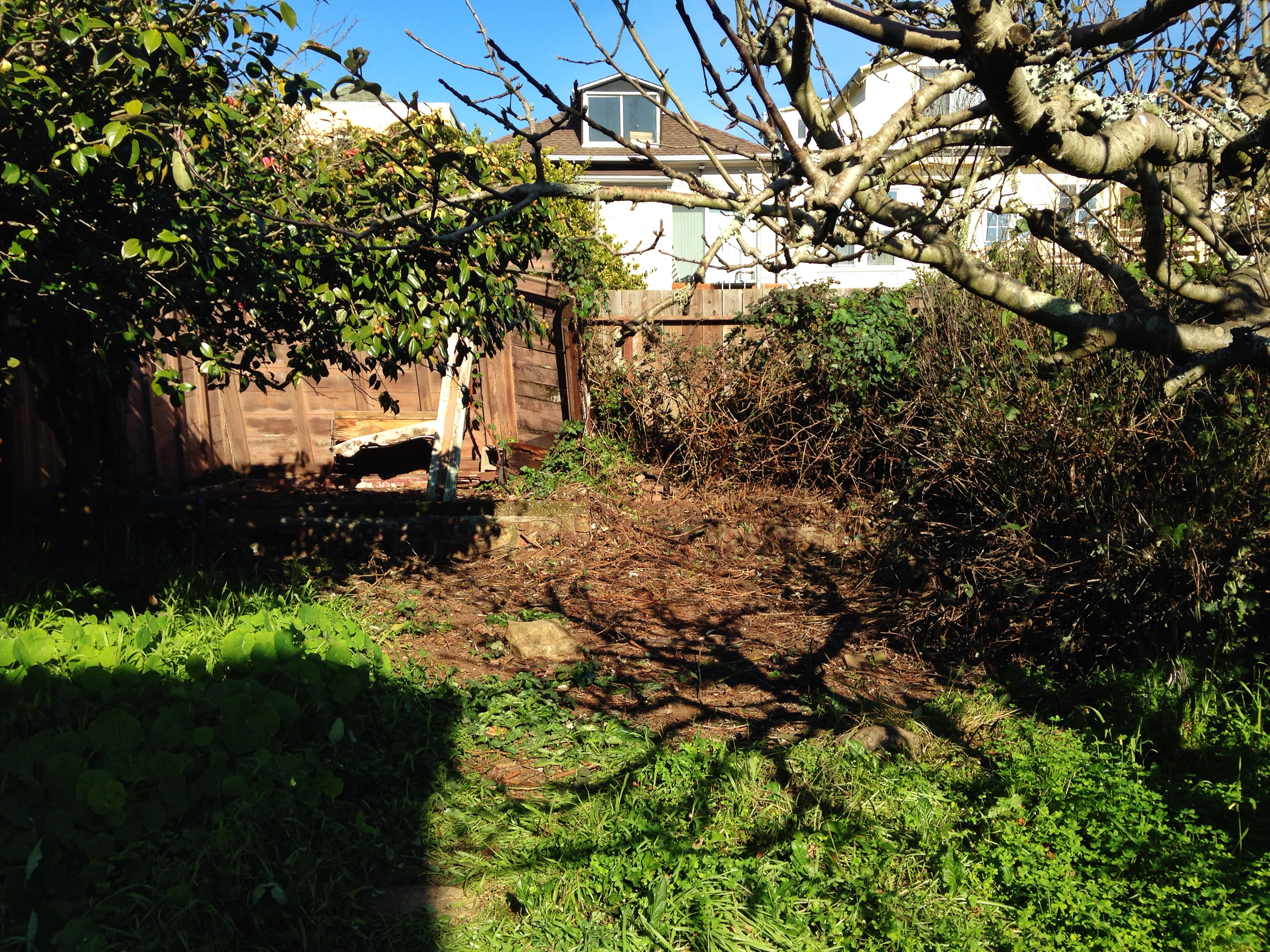
Example II: Lately I’ve been cutting through the weeds in our garden. The blackberries and anise stalks have taken over. We have a large backyard area because our lot is a standard size lot in San Francisco and our house is quite small. There is an enormous amount of space for blackberries, anise, vines, all kinds of native-growing wild foliage to thrive – with or without a drought. The weeds have grown so high over the years. Between my day job and taking classes I didn’t think there was time for working out back so the weeds flourished.

photo-1Sometimes I liked the jungle-like appearance back there but now I’d like to help create a space where my grandchildren will be able to play. Every day I go out back and weed for 1 ½ to 2 hours. I cut through the brush, pile the debris in the front of the yard and then cut the branches to fit into huge garden waste bags. I hear the birds and smell the earth and breathe the fresh air. All I have to do is step outside my own house and I’m in nature. What a pleasure it is to simply cut weeds, hear birds, and smell the earth.

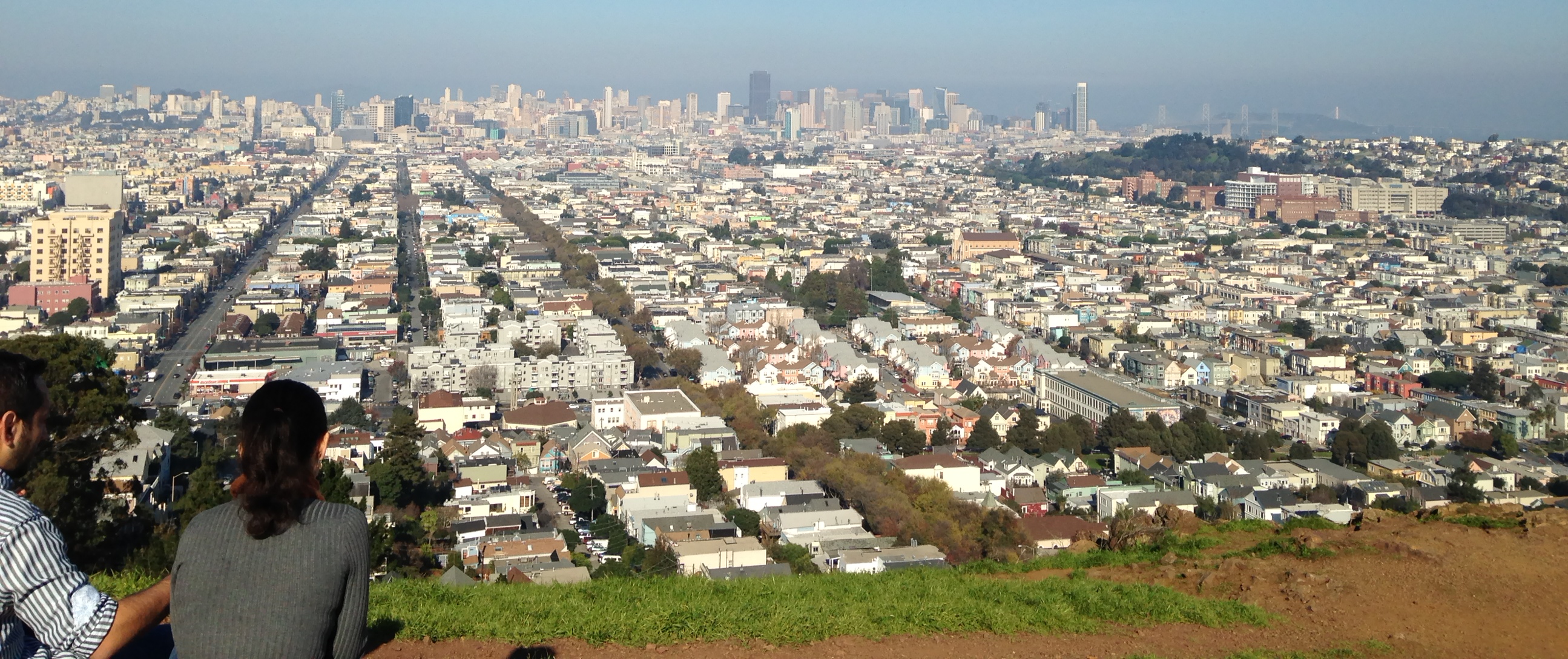
Example III: My good friend calls me in the morning. “Do you want to walk to the top of Bernal Hill?” she asks. Yes, surely I do. I eat breakfast, get dressed and we start out on our walk, catching up on what is new for each of us. We see a woman two blocks away and my friend asks her if she took art classes with her. The woman did not, though she is an artist and attends art meet-ups that my friend may want to attend. We talk with her for quite a while and we’re all quite happy to stand outside talking about our lives. My friend and I walk further, continuing our conversation about things we’re going to do in the New Year, about children, grandchildren, life, how lovely the day is. We walk for 1 1/2 hours and make it to the top of Bernal Hill. The view is amazing and the walk back is lovely also. We both know how lucky we are to be able to walk 9 miles up and down hills. We don’t take this for granted.

photo (22)Sweet onions, birds, weeds, earth, friends, conversations, sunny days, walking up and down hills – I am grateful for these simple pleasures.

The Jewish middle way

I recently was officially ordained by the International Institute for Secular Humanistic Judaism (IISHJ) as a rabbi. In preparation for my ordination I wrote three speeches. Of course, I only gave one, but here is an adaptation of the second one that I had planned to give.

What brings you here? Why are you not at a movie or sipping wine over dinner or at home reading a good book? I might ask myself the same question. We freely chose to come here tonight – to celebrate havdallah – to learn at this colloquium – to schmooze with others – a host of reasons – to get ordained . . .our choice. I think we are here because humanistic Judaism has offered us a middle way to be Jewish. What do I mean by middle way?

Some of you may have heard of the Buddhist middle way – at least those of you from California. Who has heard this story? Briefly – The story (and it is, indeed a story) about the founder of Buddhism – Siddhārtha Gautama, goes like this. The young Buddha, born into a royal family, was protected from all unpleasantness as a child and lived in a protected palace compound. One day he convinces a servant to take him outside the palace grounds and he sees a sick man, an old man, and a corpse. After realizing that he, too, would become old and ill and would ultimately die, he wanted to seek a way to handle this knowledge. He became a seeker and left his family to find a way to handle this disturbing knowledge about life. First he associated with ascetics and was so good at being a wandering monk that he almost starved to death. He ate only roots, leaves, and fruit – sometimes he ate nothing at all. He did this for 6 years. He realized that this was not the way . . .he would die if he continued to live as an ascetic. He told himself:

“Neither my life of luxury in the palace nor my life as an ascetic in the forest is the way to freedom. Overdoing things cannot lead to happiness.”

The Buddha sat all night under the Bodhi tree and vowed not to get up until he knew the way. He said:

“I will not leave this spot until I find an end to suffering.” 

He accepted milk and food to sustain him. He found a middle way between his life of luxury and his life as an ascetic and became enlightened. He understood that we cause our own suffering and that there is a way to make choices about how we approach our difficulties that release us from this suffering. This is the middle way in Buddhism, in a nutshell – on one foot, you might say. This is a path that many Jews have taken in the west; there are Zen centers, Vipassana centers, eclectic mindfulness practice programs all over the United States, many places founded and organized and led by Jews.

What if we found a Jewish middle way? A way that doesn’t leave our Jewish family behind. What would that middle way look like? Of course, some of us are practicing meditators, a practice I highly recommend, but what specifically do we mean by a Jewish middle way?

I’d like to talk about three aspects of Jewish life that scream out for finding a middle way:

  1. Tribalism and exclusivity
  2. Halakhah / law
  3. Jewish text study

Tribalism and exclusivity – Living in the bubble of Northern California makes it easy to think that Jewish exclusivity is a quality from our past. But just this year I was at a social event where someone from my Chicago south side high school showed up. I hadn’t seen her for over 45 years. I thought it would be interesting to share something I had heard from our homeroom teacher, who, coincidentally, also had moved to Northern California. The teacher said that many of the other students who were not Jewish would come to her in tears because they were left out socially. The Jewish girls were not interested in being their friends. Okay – this was 45 years ago – but, what struck me was that when I told this Jewish classmate what the homeroom teacher had said, she said, “Well – that’s how it is – like people like to be with each other. What’s the problem?” This was last year! And this woman was not religious – she was a secular Jew, raised in a secular Jewish home, who did not see any issue with Jewish exclusivity.

I’ll give you another example. I have a good friend who is Armenian. Many people think she is Jewish when they first get to know her. My friend told me that when she was working at a co-op nursery school, volunteering so that her son could attend, the mother of another child in the school – a Jewish mother – befriended her. They were becoming good friends until one day my friend said something that made it clear that she was not a Jew. The Jewish woman dropped her as a friend – like a hot potato. She is still hurt by that behavior years later.

How many of you have heard of half-Jewish.com? Raise your hands. The Half-Jewish network was founded by Robin Margolis, a women who was raised Episcopalian but found out that her mother was Jewish and began to explore her Jewish side as an adult. Being half Jewish presented her with a problem. She explains:

“The heart of the problem is that Jewish communal neglect and coldness towards adult children of intermarriage are still socially acceptable behaviors, in ways that unpleasant behavior towards other sub-groups–including interfaith couples–are increasingly not acceptable.”

The Jewish middle way, and I think we’re miles ahead of other denominations in this regard, is to welcome everyone into the fold. We need to reach out to half-Jewish adults and be welcoming. We have already begun with our official statement about what it means to be a Jew: Perhaps you all know this statement by heart, but I’m proud to repeat it:

We define a Jew as someone who identifies with the history, culture and future of the Jewish people.

I hope that the adult children who have formed a network community on half-jewish network will join us!

What is the other extreme aside from exclusivity? The other extreme that requires a move toward the middle way? More than once I’ve heard a story about someone recruiting students for Hillel or some other Jewish organization on campus. If a student is asked, “what is your background?” they may say – “Baptist,” “Catholic,” “Episcopalian.” When they say, “I’m just a person,” chances are they are Jewish. Have you heard this story? What does this mean? At the other extreme from Jewish exclusivity is an aversion to identifying as Jewish or as anything. With no positive identification why bother to identify at all? Perhaps people go to the other extreme away from Jewish exclusivity to no identification as a reaction to tribalism. Speaking for myself, I was one of those young adults who didn’t identify with the Jewish people for many years. I left running from the parochial, Conservadox world that I had rejected and didn’t see an alternative. Times have changed, however, and, as many of you have seen in the recent PEW study 95% of Jews surveyed say they are proud to be Jewish!

The middle way is here – right here in Birmingham Temple, and all of our other communities across the world! We have found the middle way. And the International Institute for Secular Humanistic Judaism (IISHJ) is leading the way to help families integrate multiple traditions in their homes. The subject of 2012 colloquium, sponsored by the IISHJ, encourages us to find new, creative ways to be “Jewish / AND” – goodbye to exclusivity!

As we will see, our three aspects of Jewish life, 1. exclusivity, 2. halakhah, and 3. text study are intertwined in many ways. Our second aspect of Jewish practice, halakhah, is something we don’t often think about in our movement. What is halakhah – the law – to us? Here is where Buddhist practice may be helpful. As we know, Jewish law for an orthodox or haredi Jew covers every aspect of life. Halakha governs what we can eat, who we can marry, how to raise our children, when we should pray, what we should say under various circumstances, how we should celebrate holidays, and so on. 613 laws – laws that make it quite difficult to not be exclusive – laws that keep us from socializing with others. At the other extreme is a way of life that advocates complete autonomy and individualism – that values the self over all else. Does this work for us? “No!” Our desires may be endless. We want what we want. We don’t want what we don’t want. We are often on a course of reactivity and desire that keeps us in a constant state of dissatisfaction. We eat a good meal . . .ahhh . . .then a couple hours later we want to eat something else – or we see a good movie – then what? read a good book – make love – drink some tea – exercise in the morning . . .eat a nice meal . . .on to the next thing . . .never quite there . . .always planning the next pleasure or avoiding something painful. Have you ever felt that edgy dissatisfaction? The Buddha called this dukkha – some translate this as suffering, but it is better translated as dissatisfaction. We want what we want – we don’t want what we don’t want . . . I find neither of these extremes – orthodox halakhah / total freedom – to be acceptable. How does Buddhist practice help us find a middle way? We can learn to be aware of where our mind takes us. Meditation is a great way to become conscious of our mind’s tendency to cause us to suffer. Mindfulness meditation makes us more aware of others around us and helps us to naturally be empathetic, rather than worrying about a law that prescribes lashon harah (gossip). Being aware of how an animal was treated may make us more careful about what we eat, rather than requiring us to be kosher – we may think about the environment or the humane treatment of the animal we may be eating or the environmental impact of the produce we are importing. There are so many ways that mindfulness practice can bring us to a naturalistic moral life – a middle way.

Which brings us to our third, and, for me, most exciting aspect of Jewish practice, Jewish text study! I had the good fortune of being required to obtain a Masters in Jewish Studies as one of my requirements in the rabbinic program at the IISHJ. I also had the good fortune of studying Jewish texts at the institute. The middle way for us is between the idolatrous regard for Torah and Talmud on the one hand and the complete disregard for these texts as not modern and, therefore, irrelevant. There is a middle way regarding the value of these texts / and a middle way is even reflected in some of these texts as well!

Conclusion:

Let us walk together on the path of the Jewish middle way. . . .where no one is ever made to feel less for not being born of the tribe . . .

Let us walk together on the path of the Jewish middle way. . . .when our diverse extended families gather together for Christmas and Hanukah and Easter and Passover.

Let us walk together on the path of the Jewish middle way. . . .meditating together . . .being mindful . . .exploring our minds’ busy distraction from what is right in front of us . . .creating a path that is forged in a natural mindful way.

Let us walk together on the path of the Jewish middle way. . . .reading Jewish texts with fresh eyes, empowered by our knowledge of history, sociology, psychology, . . .knowing our connection with all of humanity in our own particularity . . .understanding our roots not in a tribal, exclusive way, but together exploring the wisdom we may glean from our texts . . .

Now, let us go and study . . .together!

Story of four women

I recently was officially ordained by the International Institute for Secular Humanistic Judaism (IISHJ) as a rabbi. In preparation for my ordination I wrote three speeches. Of course, I only gave one, but here is an adaptation of the first one that I had planned to give.

Now – I’d like to tell you a story – this is a story about four women.

Our first woman was a poor girl from Goniondz, Poland. She was a pious Jew. She wanted to marry the rabbis’ son, likely a rabbinic student, but her father was a water carrier and there was no way that she would get her wish. Disappointed with her lot in life, she, a brave 17 year old, traveled with no one else in her family to Palestine, to Petakh Tikvah to begin a new chapter in her life. There, she met her beshert, married, and, after World War I was tricked into coming to the U.S. She thought she was just coming for a visit. She lived in Chicago for over 50 years, raised six children, prayed three times a day, cooked Shabbat dinner for multitudes – homemade gefilte fish, challah, lukshin/noodles for the soup, chicken soup, sponge cake . . .all from scratch . . .every week.

She rarely smiled.

She often spoke about how she wished she were a man. She could have been a doctor or a rabbi. When her husband died she was 78 years old. After the mourning period, she packed her bags and went back to Israel – where she wanted to be buried – She had hopes of rising after moshiakh, the messiah, comes.

The second woman was the sixth child born to a Polish Jewish orthodox mother and father in Chicago. She grew up in an African-American ghetto on the South Side, was doted on by the Irish teachers because she was white, technically a Jew, but it’s all relative from the racist perspective of those days. They would dress her up in green on St. Patrick’s Day and laud her smartness. But, she was a girl, as was her sister and there would be no further education after high school, honor society or not. She married her high school sweetheart when she turned 18. The young woman always felt that she had not been nurtured by her mother and vowed that she would be a perfect mother to her children. She was a victim of the feminine mystique that was so eloquently described by Betty Friedan in the 1960’s. She devoted her self to her three children, one of whom had severe mental difficulties that she blamed on herself. Hers was a difficult life. She kept kosher and went to synagogue every week. Her mother didn’t trust that her kitchen was kosher enough and wouldn’t eat in her home. She, too, rarely smiled.

Our third woman was a confident dutiful child. She grew up in a mixed marriage. Her mother was Orthodox and her father was from a Workmen’s Circle family. She followed the way of her mother and her two brothers followed the father. She felt superior to other Jews who were not observant. She remembers standing on a chair and preaching to her B’nai B’rith Girl club members about how important it was to follow halakhah. Her and their duty was to continue the chain of Judaism, the only authentic Judaism. Her perspective changed when she became a teenager and began to question what sort of God would allow the holocaust and, even more important, what sort of shul president owns a sweatshop, and what sort of rabbi moves out of the neighborhood when the neighborhood becomes racially integrated. In short, she became disillusioned and moved on. . . .far away from what she considered to be her narrow and parochial roots. She didn’t see a Jewish alternative at that point. There was orthodoxy or nothing (the reform weren’t really Jewish, you know).

Our third woman went to college, rabble roused, demonstrated against the war in Viet Nam, started the first underground feminist newspaper, It Ain’t Me Babe, became disillusioned with politics, became an artist, married, and had two children. As for Judaism, that was a memory from the past, only associated with orthodoxy in her mind.

Everything changed when she attended her cousin’s wedding in Ann Arbor, Michigan, officiated by Rabbi Sherwin Wine. She enjoyed the ceremony. Afterwards her mother said, “that Rabbi is an atheist.” She became intrigued and read his book Judaism Beyond God. As for many of you here today, her journey began with that book – a book that described the sort of Jew she was. She smiled fairly often.

Our fourth woman treasured her Jewish identity as a child, but had a rather amorphous non-institutional experience of being a Jew. She thought that she and her family had actually been slaves in Egypt – After all, those words ARE said during the Passover seder. She enjoyed lighting candles on Hanukah, especially liked those eight gifts, enjoyed trimming her neighbors’ Christmas tree and exchanging gifts with them and her family on Christmas Eve. One year she requested that her family get a tree for Christmas and her mother bought her a small one for her room because her mother wasn’t comfortable with the tree in the main part of the house. She ended up discarding the tree because she felt uncomfortable once it was there in her own room. She had many friends and many of her closest friends were Catholic. She never discriminated against anyone because of their religion or class. She was comfortable with all kinds of people and would never accept any idea of Jewish chosenness. She grew up, became a therapist, married a secular Christian, and had a baby. Now she always sets up a guilt-free Christmas tree AND a lights her Chanukiah and would like to join a community that values her Jewishness equally with her husband’s Christian background. She smiles quite often.

____

For those of you who have not yet guessed – The first woman was my grandmother, Mina (called Minny), the second was my mother, Baylie (called Beverly). I’m the third, and my daughter, Shana is the fourth.

­­

These four women, myself included, illustrate the limits and gains for Jewish women in the last 100 years – my grandmother, the orthodox Jewish frum Eastern European immigrant and pioneer in the second aliyah; my mother, first generation American wanting to fit in, wanting to be observant, and wanting be a perfect mother, raising three perfect children; myself, a boomer activist, wanting to change the world, and my millennial daughter, completely acculturated – the fourth generation.

____

We’ve come a long way.

I’d like now to switch to the first person in order to further share my own journey with you. After I read Judaism Beyond God, my plan was to start a local chapter of the Society for Humanistic Judaism (SHJ) once the kids were older. Several years later, my daughter told us about what she had learned about multi-culturalism in her middle school class. She and her good friend Beth, the two white girls, felt left out. What were they? They didn’t seem to count. The time was right to look for a Jewish community that shared our values. And it turned out that I didn’t have to start a group because it already existed. When I looked in our local Jewish newspaper for a community to celebrate Yom Kippur, there was the ad posted by the Bay Area SHJ, now called Kol Hadash)! We attended the Yom Kippur service, were encouraged to join, and shortly thereafter I was asked to go through the training to become a madrikah and lead this group.

Thus began my journey back to Judaism. We humanists do not often put it that way. Return to Judaism, for many, implies a return to orthodoxy, or to what is considered to be traditional Judaism. But what I’ve learned in the rabbinic program has opened my eyes to the reality that Judaism is, and more important, has opened my eyes to the reality that Judaism was. Normative rabbinic Judaism has more in common with our point of view than we might think! We do not need to be afraid to own it. We define Judaism. We continue the chain. We do this in an open, welcoming, intercultural, sometimes, interfaith way. We are not confined by halakha, the law, and are able to creatively move Judaism forward into the 21st century.

The IISHJ taught me my history, including the history of our holidays, the cultural milieu for the formation of rabbinic Judaism and Christianity, counseling, community building, Jewish education, and ancient history (the context of our biblical texts), and what a rich history this is! My 10- year Hebrew School education pales in comparison. I had no idea what Judaism was when I was growing up. I just followed the rules – no questions asked. What a revelation this was to see our rich and varied history!

I’d like to share the highlights of my rabbinic education . . what excites me and what I would like to share with others.

One of the most demanding and at the same time exciting classes I took was taught by Brian Schmidt from University of Michigan. I learned about the historical context of the creation of the Bible, many perspectives about how much is true in the Bible and how much is mythology – the minimalist and maximalist perspectives. I had to create maps and timelines; I was challenged to my limits!

I learned about how exciting it is to study Torah. Yes, exciting! We do not have to treat Torah as a sacred object in order to benefit from its study. Torah can serve as Jewish memory, may provide us with clues to our history, and, most important may encourage discussions about our values. We don’t have to exclusively study Torah or Talmud. There is great literature of all kinds for us to study, but we would be missing much if we were to reject Jewish texts because of the limited way they’ve been used in the past.

Another exciting class that I took at the Institute was taught by Gabrielle Boccacini. In this class I learned that rabbinic Judaism and Christianity equally grew out of the second temple period. There is no normative form of Judaism in the second temple period! Christianity is our sibling, not our usurper. This knowledge has implications for interfaith and intercultural communities. Once you remove the Christian supersessionist and Jewish chauvinist points of view – once you see these religious traditions as siblings, one has a better chance for dialogue than if one believes the other is superseded or inauthentic.

In my Jewish cultures class, I learned about the Jews of Central Asia, Bukharan Jews who had similar dress and customs as their Muslim neighbors. I learned about my ancestors, the Ashkenazi Jews, especially the history of the Jews of Poland, their happy time there (yes, you heard right – happy time) – a time we rarely hear about because of the last tragic years, the rich Yiddish culture and multiple political and Zionist groups that formed in the later years. Also, I learned about Israel. In the Israel component of the class, we each created a timeline of our lives and our instructor, Rabbi Sivan Maas, wrote out the dates 1948, 1967, 1973, and so on – dates of war in Israel, giving us a graphic sense of the power of these dates for those who live in Israel.

From Adam Chalom I learned about the roots of humanistic Judaism – about Spinoza, the Enlightenment, the Reform movement, Wissenschaft des Jutentums, about the Yiddishists and Jewish Socialists, Zionism, and secular and modern Jewish thought.

From Miriam Jerris I learned about the nitty gritty of starting communities, the joys and the pitfalls, the serious hard organization work that must be done in order to ensure the solidity of our communities.

I read Talmud and learned that the editors/redactors of the Babylonian Talmud, the Bavli, re-contextualized stories to make points that they wanted to make. My final thesis was about the story of the oven of Akhnai, a popular story that has a meaning that may be quite different than the popular meanings attributed to it. Ask me about this sometime when you have a while to talk! It’s a fascinating story.

The most important point I would like to make here is that because Talmud has been studied mainly in the yeshivah, we are under the impression that only the orthodox have the knowledge or skill to study it. But, since the orthodox are mainly interested in halakhah, they are missing an opportunity to look at the complete cultural milieu in which the final Babylonian Talmud (the Bavli) was redacted. In this enormous body of text, we can learn history, culture, literature, how people thought at different times in the history of particular texts, what the final redactors were trying to teach, how the final redactors were not trying to make hard and fast rules about Judaism – let me say that again, how the final redactors were not trying to make hard and fast rules about Judaism! We, humanistic Jews may be more in sync with the redactors and writers of the Bavli, than the orthodox are. Wow!

_____

Jewish learning is now my passion. I have become the rabbi my grandmother wanted to marry and the rabbi she could have been if she had been born 60 years later than she was. Although she would not approve of a Jewish life without halakhah, humanistic Judaism made it possible for me to fulfill her fantasy, if not her dream.

I am grateful to my mother for raising me to be confident and to my daughter for stimulating my search for a way for our family to affiliate with the Jewish community. I’m grateful that I was able to help my son and daughter-in-law create their interfaith Jewish-Jewish wedding ceremony: Abi, my daughter-in-law wanted Hebrew prayers and Zev, my son, wanted humanistic words. I’m grateful to my cousins Matthew and Leslie for inviting me to their wedding – where I was introduced to humanistic Judaism. I am especially grateful to my husband for all of his support. And thank you, Rabbi Wine and all of you who created the only branch of Judaism with which I can affiliate.

Now, let’s go and study / together!
Thoughts about the holidays

Chanukah and Christmas are over. The light of these holidays helped many of us get through the darkest time of the year, symbolizing and encouraging hope in the midst of darkness. There were parties. There were gifts. There were colorful posts to be seen on Facebook and good cheer shining forth on our smart phones, tablets, and computer screens.

That said, I’m always relieved when the holidays are over. I worry about not doing enough, not feeling cheerful enough, not meeting everyone’s expectations, not fitting in. I’m old enough to know that Chanukah is a minor holiday, and old enough to have grown up in a time when there was no way that Chanukah could measure up to Christmas. Maybe this is still true for most Jews, but when I was a child there wasn’t even an attempt to make it meaningful and exciting. Also, now that I know the real story of Chanukah, I understand why the rabbis of old wrote the miracle of the oil part rather than focusing on celebrating the victory of the Maccabees during a civil war.

Where does this leave me? Every year I try to find meaning in Chanukah and Christmas. I will not ignore Christmas, as I was encouraged to do as a child. I want to understand my Christian friends and family. So, what meaning do I find in these winter holidays? Now, for me, Chanukah is about light in darkness, hope in the middle of despair, and the importance of individual choice regarding religious practice, and Christmas is about new beginnings and the potential of a helpless baby to develop and become compassionate and loving. As a humanist I believe that we all can be hopeful, free, compassionate, and loving.